Vulcan: The Tunisian Campaign
Vulcan is a third entry in R. T. Smith's World War II trilogy, including Arnhem and Desert Rats. It simulates the Tunisian Campaign in 1942-43 from the arrival of the 'Torch' Task Force and their race for…
Vulcan: The Tunisian Campaign is a turn-based strategy (tbs), released 31 December 1986 on Amiga, Amstrad CPC, Atari ST/STE and DOS.
What Vulcan: The Tunisian Campaign is
Vulcan: The Tunisian Campaign was released in 1986. It was published by Cases Computer Simulations. It is available on Amiga, Amstrad CPC, Atari ST/STE, DOS and ZX Spectrum.
The premise, in the publisher's words
Vulcan is a third entry in R. T. Smith's World War II trilogy, including Arnhem and Desert Rats. It simulates the Tunisian Campaign in 1942-43 from the arrival of the 'Torch' Task Force and their race for Tunis, to the final battle of 'Operation Vulcan'. There are 5 armies (3 Allied & 2 Axis) and 5 scenarios, including the battles of Kasserine and Mareth. Each scenario has several pre-conditions to start from, which include Axis control Malta, Axis capture Bone, DAK (Deutsches Afrika Korps) destroyed, Desert armies late, and French neutrality.
How it plays
It is played from a first person perspective. Its themes are historical and warfare. It is a single-player game with no multiplayer component. Available modes: Multiplayer and Single player.
What it launched against
Vulcan: The Tunisian Campaign launched on 31 December 1986, within three weeks of World Games, Gauntlet, The Sentinel and Leaderboard.
Released around the same time: World Games, Gauntlet, The Sentinel, Leaderboard.
Screenshots
All media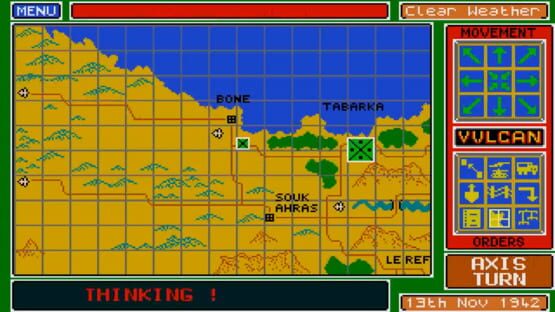
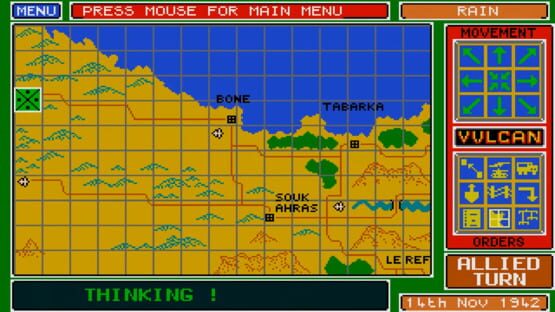
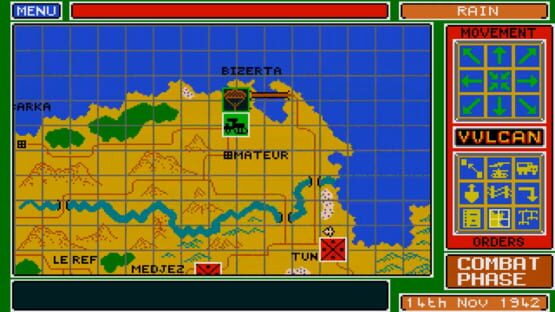
Quick answers
Vulcan: The Tunisian Campaign — frequently asked questions
When did Vulcan: The Tunisian Campaign come out?
If you like this
Games like Vulcan: The Tunisian Campaign
 82
Age of Empires IV
 82
Total War: Three Kingdoms
Three Kingdoms: Fate of the Dragon
Order of Battle: World War II
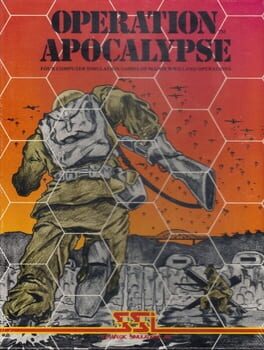
Operation Apocalypse
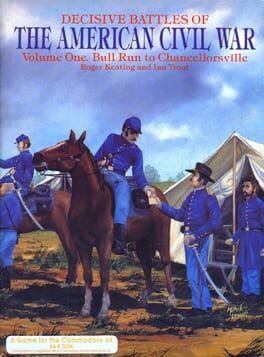
Decisive Battles of the American Civil War, Volume One
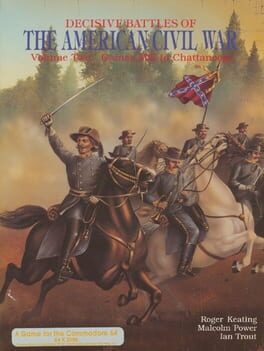
Decisive Battles of the American Civil War, Volume Two